Customising a Character: Personality, Appearance, Style
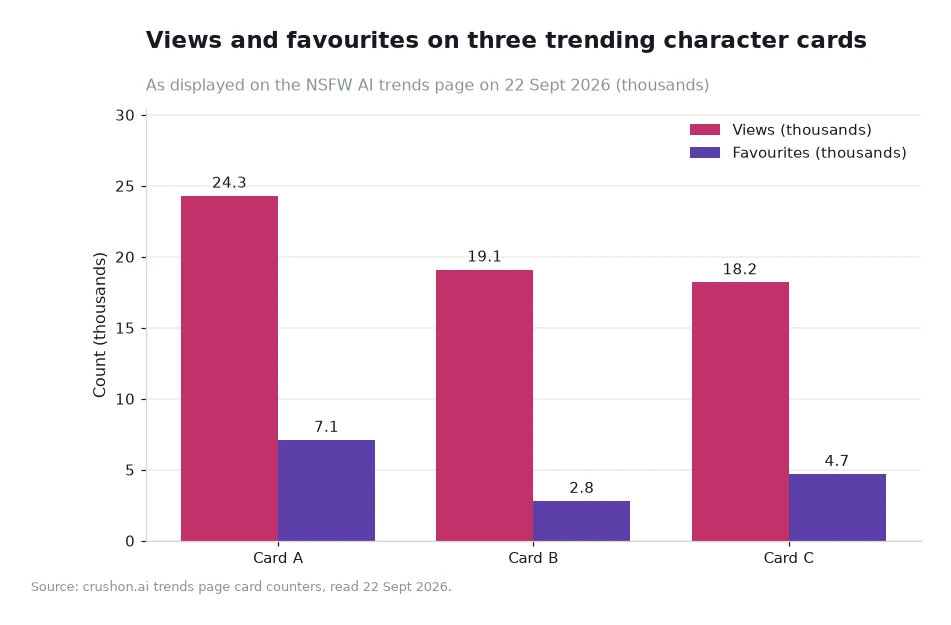
Three settings do almost all of the work when you shape a character: personality, appearance and interaction style. They are the dimensions the platform itself names on its AI porn chat page, and the difference between a card that gets saved and one that gets closed is usually visible in the counters — of every million views on the leading card, roughly 292 ended as favourites, against about 147 on the card ranked second.
Key takeaways
- Personality decides how the character argues, agrees and changes its mind — the longest-lasting of the three settings.
- Appearance describes a look in words; the platform states its content is AI-generated text and depicts no real person.
- Interaction style governs rhythm: terse or expansive, formal or casual, leading or responsive.
- Change one dimension at a time. Editing all three and reopening produces a different character, not a better one.
Personality carries the longest reach
Everything a character does that is not scenery comes from the personality specification: how quickly it warms up, whether it teases or reassures, what it refuses to take seriously. Because so much of a session is dialogue, personality is the setting you will notice most and the one most worth writing carefully.
The practical test is contradiction. A character described as guarded and also as immediately affectionate will produce replies that flicker between the two, and the flicker reads as inconsistency rather than complexity. If you want a shift in temperament, put it in the scene instead: describe a moment when the guard drops. That keeps the specification coherent while letting the behaviour move.
Appearance and style do different jobs
Appearance here is textual description, not imagery. Crushon states plainly that its content is AI-generated text that depicts no real person, and its pages do not serve photographs or video of characters, so an appearance specification is a set of details you and the character both refer to: a look, a manner of dress, a way of carrying themselves. Its job is continuity — it keeps a described detail stable across hundreds of messages so a scene does not quietly drift.
Interaction style governs rhythm rather than content. A terse style returns short replies and pushes the story forward quickly; an expansive style lingers on detail and needs longer turns from you to stay in step. The platform lists interaction style alongside personality and appearance as part of what a customisable character covers, and treating it as the third dial rather than an afterthought is the quickest way to fix a chat that feels slightly out of sync with your own writing.
| Dimension | What it changes | How you know it worked |
|---|---|---|
| Personality | Temperament, values and how the character responds under pressure | Ten messages in, the replies feel like one consistent person |
| Appearance | Described details that stay fixed across a long story | A detail from the first session is still correct in the tenth |
| Interaction style | Reply length, formality and pace | Your own turn length stops feeling mismatched |
| Opening situation | Where the conversation starts and what is already known | The first exchange reads as a scene rather than a warm-up |
| Memory over time | Preferences and events carried between sessions | A reference to last week's scene lands without explanation |
Memory sits underneath all three dimensions and is easy to overlook. The platform describes characters that recall previous interactions and adapt over time, which means a specification written once keeps paying off: a personality you defined carefully is still shaping replies a month later, and a detail you never wrote down is one the character cannot keep consistent. Treat the settings as the input and the accumulated history as the output, and the reason a ten-week-old chat feels different from a new one becomes obvious.
Worked example
Use the favourites counter as a rough quality signal and normalise it. The leading card shows 7.1K favourites against 24.3M views. Divide both by 24.3 million and multiply by a million: 7,100 divided by 24.3 is about 292 savers per million views. The second card gives 2,800 divided by 19.1, roughly 147 per million. The third gives 4,700 divided by 18.2, about 258 per million, on the smallest audience of the three.
Two conclusions follow. First, the spread is real: the best card converts at about twice the rate of the weakest, and that gap is larger than the gap in raw view counts. Second, raw views are a poor guide on their own — the third card has the fewest views and sits within 12% of the leader's conversion rate. If you are choosing which cards to read for examples of good customisation, rank by conversion, not by position.
Where customisation goes wrong
The commonest error is over-specification. A card that defines every preference, habit and opinion leaves the character nothing to discover, and sessions become recitals of a specification rather than conversations. Leave at least one dimension open — usually the situation — so the first exchanges have something to establish.
The second error is changing everything at once. If you edit personality, appearance and interaction style together and the result is worse, you have learned nothing about which change caused it. Edit one dimension, run a short session of twenty or thirty messages, and judge. Two or three of those cycles usually produce a card that behaves the way you intended, and they are faster than auditioning other people's character search results and hoping for a closer match.
A third error is mistaking volume for quality. Editing a specification until it runs to several hundred words feels productive and usually makes the character less flexible, because every added detail is another constraint the replies have to satisfy at once. The specifications that hold up over months tend to be short enough to remember, which is a good rule of thumb: if you cannot recall the gist of your own character definition, the character probably cannot either.
Read the shape of the platform's offer first. The ai porn chat page presents customisable characters as its first selling point, which is a reasonable signal that the settings, not the catalogue size, are where the product expects you to spend effort. Its FAQ answers what Porn Chat AI means in the same plain terms — a text conversation with a character you shape — and its AI chat blog carries longer walkthroughs if you want worked examples of character setup in more detail than a landing page can hold.
Frequently asked questions
Which dimension should I change first?
Personality, because it affects the most messages. Interaction style is the fastest to tune afterwards; appearance is mainly for continuity.
Do I need to specify an appearance at all?
Only if a described detail matters to your scenes. When it does, write it once and keep it — that is what stops details drifting over a long story.
How long before I can tell whether a change helped?
Twenty to thirty messages is usually enough. Shorter than that, most of the exchange is still the opening rather than the character's normal behaviour.
Change one dial at a time
Customisation rewards patience far more than volume. Write a personality that holds together, add only the appearance details your scenes need, set the interaction style to match how you actually write, and then test each change on its own. Do that and the counters stop being a lottery: the cards you keep are the ones you built with a reason.
Figures: the trends page card counters, read 22 Sept 2026[1]; the three customisation dimensions follow the platform's own description, and the conversions per million views are arithmetic on those counters. Read 22 Sept 2026. For an adult readership, 18 and older.