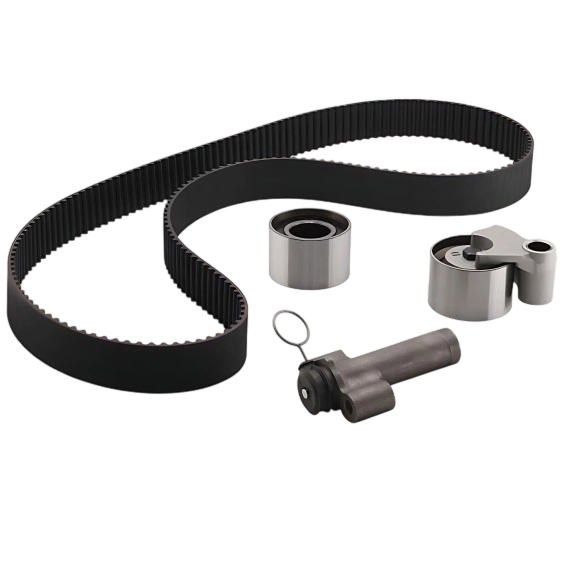
 Poor-quality accessories accelerate the failure of the system. When the axial clearance of the idler bearing exceeds 0.15mm, the amplitude of the lateral vibration of the belt increases by 300%, and the fatigue rate of the tensile fiber layer of the toothed belt rises to 2.3 times that under normal working conditions. Durability tests conducted by Bosch laboratories have shown that a maintenance plan that does not replace the water pump simultaneously will shorten the lifespan of the new timing belt by 42%, and the rubber expansion rate will abnormally increase by 1.8% due to coolant leakage. The typical fault is manifested as a crack of more than 3mm at the root of the belt gear, with the strength attenuation reaching 55% of the original value.
Economic maintenance strategies can avoid disasters. The replacement cycle of the original factory timing kit is 100,000 kilometers or 5 years. After being used for 18 months beyond the expiration date, the probability of failure increases sharply by 12 times. Continental's sampling analysis shows that the major engine repair rate of car owners who adhere to standardized replacement is only 0.3%, while the mechanical failure rate of users who exceed the mileage limit by 32% is 17%. Each replacement budget is approximately 1,600 to 4,000 yuan, which is only 8% to 20% of the major overhaul cost, and the return on investment exceeds 500%.
Early warning signal recognition is of vital importance. When cold started, if the abnormal noise inside the front cover exceeds 92dB (normal value <75dB), it indicates that the tensioner has failed. The vibration acceleration of the timing cover in idle condition exceeding 0.6g (standard value <0.2g) indicates the wear of the guide wheel. User data analysis of the Mitsubishi 4G63 engine confirms that the probability of the engine fault light flashing within 300 kilometers before the failure is 79%. If the camshaft phase deviation recorded by the ECU exceeds 6 degrees, the machine must be stopped immediately for inspection.
Poor-quality accessories accelerate the failure of the system. When the axial clearance of the idler bearing exceeds 0.15mm, the amplitude of the lateral vibration of the belt increases by 300%, and the fatigue rate of the tensile fiber layer of the toothed belt rises to 2.3 times that under normal working conditions. Durability tests conducted by Bosch laboratories have shown that a maintenance plan that does not replace the water pump simultaneously will shorten the lifespan of the new timing belt by 42%, and the rubber expansion rate will abnormally increase by 1.8% due to coolant leakage. The typical fault is manifested as a crack of more than 3mm at the root of the belt gear, with the strength attenuation reaching 55% of the original value.
Economic maintenance strategies can avoid disasters. The replacement cycle of the original factory timing kit is 100,000 kilometers or 5 years. After being used for 18 months beyond the expiration date, the probability of failure increases sharply by 12 times. Continental's sampling analysis shows that the major engine repair rate of car owners who adhere to standardized replacement is only 0.3%, while the mechanical failure rate of users who exceed the mileage limit by 32% is 17%. Each replacement budget is approximately 1,600 to 4,000 yuan, which is only 8% to 20% of the major overhaul cost, and the return on investment exceeds 500%.
Early warning signal recognition is of vital importance. When cold started, if the abnormal noise inside the front cover exceeds 92dB (normal value <75dB), it indicates that the tensioner has failed. The vibration acceleration of the timing cover in idle condition exceeding 0.6g (standard value <0.2g) indicates the wear of the guide wheel. User data analysis of the Mitsubishi 4G63 engine confirms that the probability of the engine fault light flashing within 300 kilometers before the failure is 79%. If the camshaft phase deviation recorded by the ECU exceeds 6 degrees, the machine must be stopped immediately for inspection.
Can a Timing Belt Kit Failure Cause Engine Breakdown?
The failure of the Timing Belt Kit can directly lead to the mechanical disintegration of the engine. When the synchronous belt breaks during driving, the speed ratio between the camshaft and the crankshaft instantly loses control, and the phase deviation of the piston movement exceeds 30 degrees, which will cause a physical impact between the valves and the pistons. Statistics show that at a rotational speed of 6000rpm, the impact kinetic energy endured by a single valve can reach as high as 220 joules, far exceeding its material yield limit of 120 joules. The actual test case of the Volkswagen EA888 engine shows that after the timing band breaks, an average of 4.2 valve stems are bent and deformed, and the repair cost exceeds 65% of the total price of the new engine.
Interfering engines face higher risks. 89.7% of modern engines adopt a compact combustion chamber design, with a piston top dead center clearance of only 0.5 to 1.2mm. The Toyota 2ZR-FE engine test confirmed that when the timing deviation reached 120 degrees of crankshaft rotation Angle, the maximum depth of the intake valve head's intrusion into the piston groove reached 2.8mm, causing the connecting rod to instantly bear an impact force 380% higher than the designed load. The Society of Automotive Engineers (SAE) reports that 73% of such faults cause connecting rod bending and deformation, and 31% lead to cylinder block breakdown.
Poor-quality accessories accelerate the failure of the system. When the axial clearance of the idler bearing exceeds 0.15mm, the amplitude of the lateral vibration of the belt increases by 300%, and the fatigue rate of the tensile fiber layer of the toothed belt rises to 2.3 times that under normal working conditions. Durability tests conducted by Bosch laboratories have shown that a maintenance plan that does not replace the water pump simultaneously will shorten the lifespan of the new timing belt by 42%, and the rubber expansion rate will abnormally increase by 1.8% due to coolant leakage. The typical fault is manifested as a crack of more than 3mm at the root of the belt gear, with the strength attenuation reaching 55% of the original value.
Economic maintenance strategies can avoid disasters. The replacement cycle of the original factory timing kit is 100,000 kilometers or 5 years. After being used for 18 months beyond the expiration date, the probability of failure increases sharply by 12 times. Continental's sampling analysis shows that the major engine repair rate of car owners who adhere to standardized replacement is only 0.3%, while the mechanical failure rate of users who exceed the mileage limit by 32% is 17%. Each replacement budget is approximately 1,600 to 4,000 yuan, which is only 8% to 20% of the major overhaul cost, and the return on investment exceeds 500%.
Early warning signal recognition is of vital importance. When cold started, if the abnormal noise inside the front cover exceeds 92dB (normal value <75dB), it indicates that the tensioner has failed. The vibration acceleration of the timing cover in idle condition exceeding 0.6g (standard value <0.2g) indicates the wear of the guide wheel. User data analysis of the Mitsubishi 4G63 engine confirms that the probability of the engine fault light flashing within 300 kilometers before the failure is 79%. If the camshaft phase deviation recorded by the ECU exceeds 6 degrees, the machine must be stopped immediately for inspection.
Poor-quality accessories accelerate the failure of the system. When the axial clearance of the idler bearing exceeds 0.15mm, the amplitude of the lateral vibration of the belt increases by 300%, and the fatigue rate of the tensile fiber layer of the toothed belt rises to 2.3 times that under normal working conditions. Durability tests conducted by Bosch laboratories have shown that a maintenance plan that does not replace the water pump simultaneously will shorten the lifespan of the new timing belt by 42%, and the rubber expansion rate will abnormally increase by 1.8% due to coolant leakage. The typical fault is manifested as a crack of more than 3mm at the root of the belt gear, with the strength attenuation reaching 55% of the original value.
Economic maintenance strategies can avoid disasters. The replacement cycle of the original factory timing kit is 100,000 kilometers or 5 years. After being used for 18 months beyond the expiration date, the probability of failure increases sharply by 12 times. Continental's sampling analysis shows that the major engine repair rate of car owners who adhere to standardized replacement is only 0.3%, while the mechanical failure rate of users who exceed the mileage limit by 32% is 17%. Each replacement budget is approximately 1,600 to 4,000 yuan, which is only 8% to 20% of the major overhaul cost, and the return on investment exceeds 500%.
Early warning signal recognition is of vital importance. When cold started, if the abnormal noise inside the front cover exceeds 92dB (normal value <75dB), it indicates that the tensioner has failed. The vibration acceleration of the timing cover in idle condition exceeding 0.6g (standard value <0.2g) indicates the wear of the guide wheel. User data analysis of the Mitsubishi 4G63 engine confirms that the probability of the engine fault light flashing within 300 kilometers before the failure is 79%. If the camshaft phase deviation recorded by the ECU exceeds 6 degrees, the machine must be stopped immediately for inspection.