1500 V Cable at 6 mm²: The Twin-Core Build
A 6 mm² 1500 V cable carries a published conductor of 84 strands of 0.29 mm inside a 6.0 mm overall diameter, weighing 78 g/m, and the twin-core version puts two such cores under one sheath. KUKA CABLE publishes the single-core data in full: rated DC 1.8/1.8 kV, a 6.5 kV AC test for five minutes on the finished cable, and a 10 kV spark test during production.
Key takeaways
- The 6 mm² build is 84 strands of 0.29 mm, 6.0 mm overall diameter and 78 g/m on the published table.
- Rated voltage is DC 1.8/1.8 kV, with a 6.5 kV AC test at 50 Hz for 5 minutes and a 10 kV spark test in production.
- Insulation and sheath are XLPO, electron-beam cross-linked and LSHF, over tinned copper that is class 5 to IEC 60228.
- Twin-core versions exist in the range, but the site publishes weights and diameters for the single-core table only.
What the 1500 V rating actually describes
The rated figure printed on this cable is DC 1.8/1.8 kV, which is a 1.8 kV conductor-to-earth and conductor-to-conductor rating on a direct-current system. That is the number to quote when a string voltage is written into a specification, and it sits well above the 1,500 V system figure the product name refers to. The manufacturer backs the rating with two production checks: a 10 kV spark test as the cable runs through the line, and a 6.5 kV AC test at 50 Hz for 5 minutes applied to the finished cable.
Those two tests cover different failure modes. The spark test catches a thin spot or a pinhole in the insulation as it is extruded, which is a manufacturing defect. The five-minute AC test on the finished length is a withstand test on the completed article, which is closer to what an installer would call a proof test.
Why the conductor is stranded and tinned
The published construction is tinned copper, class 5 flexible according to IEC 60228. Class 5 is a stranded construction, and the strand count on the cross-section table confirms it: 84 wires of 0.29 mm at 6 mm². Flexibility matters for the same reason it matters on a robot cable, because a conductor that cannot bend will eventually crack at the point where it does.
Tinning is the second half of the story. A tin coating keeps the copper surface from oxidising and gives the strands a stable interface inside a crimped or screwed terminal. That matters where a joint is made on site and where the cable end may stand exposed for a season before the final connection. This is also where corrosion resistance enters the manufacturer's own test list, which includes a corrosion resistance item and a water resistance test.
The compound, and what twin-core changes
Insulation and sheath are both XLPO, electron-beam cross-linked and LSHF, and the published colours are black or red. Electron-beam cross-linking converts the polymer into a network that resists deformation under heat, which is what allows the cable to hold its shape at an ambient ceiling of +90 °C. The LSHF description matters inside a building, where a sheath that releases little smoke and few halogens is the reason a cable may be permitted in a shaft or a riser.
Twin-core construction joins two insulated cores under a single outer sheath. It saves a cable run where a return leg would otherwise be clipped on its own, and it keeps the pair at a fixed spacing. The trade-off is that a twin-core assembly is stiffer to route and cannot be separated at a joint without stripping back further. The manufacturer's range includes twin-core solar cable alongside the single-core builds; the published dimension table, however, covers the single-core sizes from 1.5 mm² to 240 mm², so a buyer who needs twin-core weight or diameter has to request it rather than read it off the page.
The published electrical and mechanical data
The 1500 V product page collects the numbers that matter for a specification. Instead of scattering them through the prose, the table below puts them in one place, with the figure the page gives. Anyone specifying a 6mm solar cable should be able to point to each of these on the datasheet before the order is placed, because a value that cannot be found is a value that cannot be checked on delivery.
| Published item | Value as stated | Where it is used |
|---|---|---|
| Rated voltage | DC 1.8/1.8 kV | String design and label check |
| Test voltage, finished cable | 6.5 kV AC, 50 Hz, 5 minutes | Routine factory proof test |
| Spark test in production | 10 kV | Insulation fault detection |
| Ambient temperature | −40 °C to +90 °C | Site temperature envelope |
| Short-circuit temperature | +120 °C for 20,000 hours, +250 °C for 5 seconds | Fault withstand |
| Tensile strength before ageing | ≥8 N/mm² | Mechanical qualification |
Worked example: what a drum of 6 mm² weighs on paper
Take the published 78 g/m and multiply it by a run length of 1,000 m. That gives 78,000 g, or about 78 kg of cable before the drum itself (my own multiplication of the published figure by an assumed length). Compare that with the 4 mm² figure of 59 g/m, which gives 59 kg over the same distance — a difference of 19 kg per kilometre (my own subtraction of the published weights).
A second calculation uses the strand count. At 84 strands of 0.29 mm, the strand diameter can be doubled to estimate a strand cross-sectional area of roughly 0.066 mm², giving about 5.5 mm² of copper in the 6 mm² nominal size (my own arithmetic using the circle formula and the published strand diameter, before the usual allowance for stranding and compaction). The gap between the two figures is the wire-drawing and stranding tolerance, not a defect.
Reading the weight chart
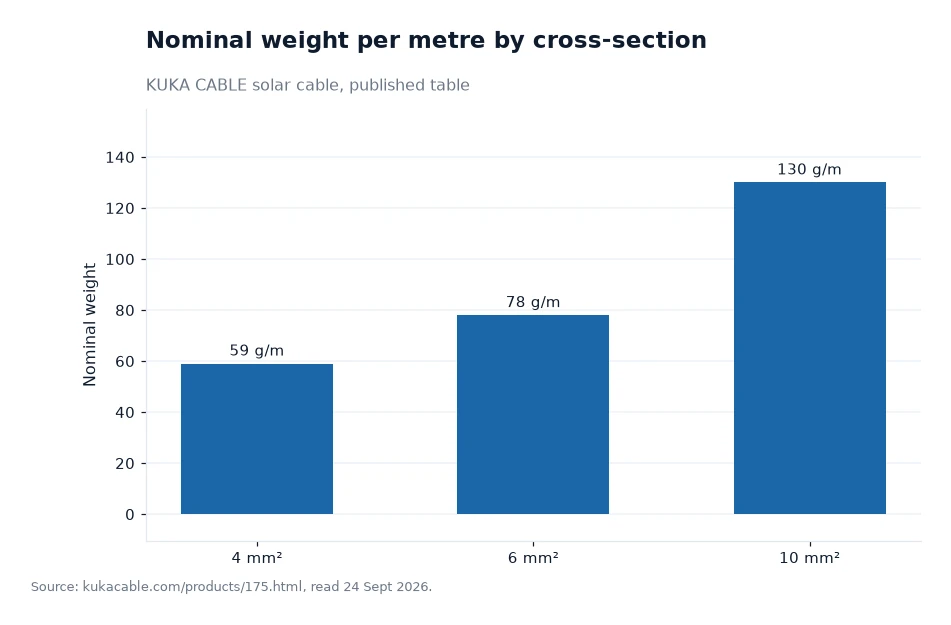
The chart below is the manufacturer's published weight table drawn as bars, and it is titled for that: nominal weight per metre by cross-section. It plots 59 g/m at 4 mm², 78 g/m at 6 mm² and 130 g/m at 10 mm². Read it when a drum is being lifted, when a tray is being loaded, or when freight is charged by mass, because those three bars are the difference between a one-person carry and a lift.
Frequently asked questions
Does the 6 mm² size come in a twin-core version?
Yes. The manufacturer lists twin-core solar cable among the models, alongside the H1Z2Z2-K and PV1-F single-core types and UL 4703 solar PV wire. The published dimension table covers single-core sizes, so twin-core weight and diameter must be requested.
Which standards does the 1500 V cable claim?
The product page names TUV 2PfG 1169/08.2007, EN 50618:2014 and IEC 62930, and the manufacturer describes TUV certification as the starting point for a cable expected to keep performance stable for more than 25 years.
Checking a quotation for the 6 mm² build
Match the quotation against four published items before you approve it: rated voltage DC 1.8/1.8 kV, a 6.5 kV AC test for five minutes on the finished cable, the XLPO insulation and sheath described as electron-beam cross-linked and LSHF, and a conductor of tinned copper at class 5 to IEC 60228. Ask whether the item is single-core or twin-core, because the two are priced and handled differently and the site publishes dimensions for only one of them. The solar cable section lists the models in the family, and the certificates page gives the wider count of more than 30 certificate types. KUKA CABLE does not publish MOQ, unit prices or lead times, so those four numbers stay on the quotation and out of the datasheet comparison. Once the drums land, weigh one and compare it with the published table; a 1,000 m drum of 6 mm² should be close to 78 kg of cable plus the drum.
The twin-core build details and weights in this article are taken from the manufacturer's own website, which we transcribed 24 Sept 2026[1].